

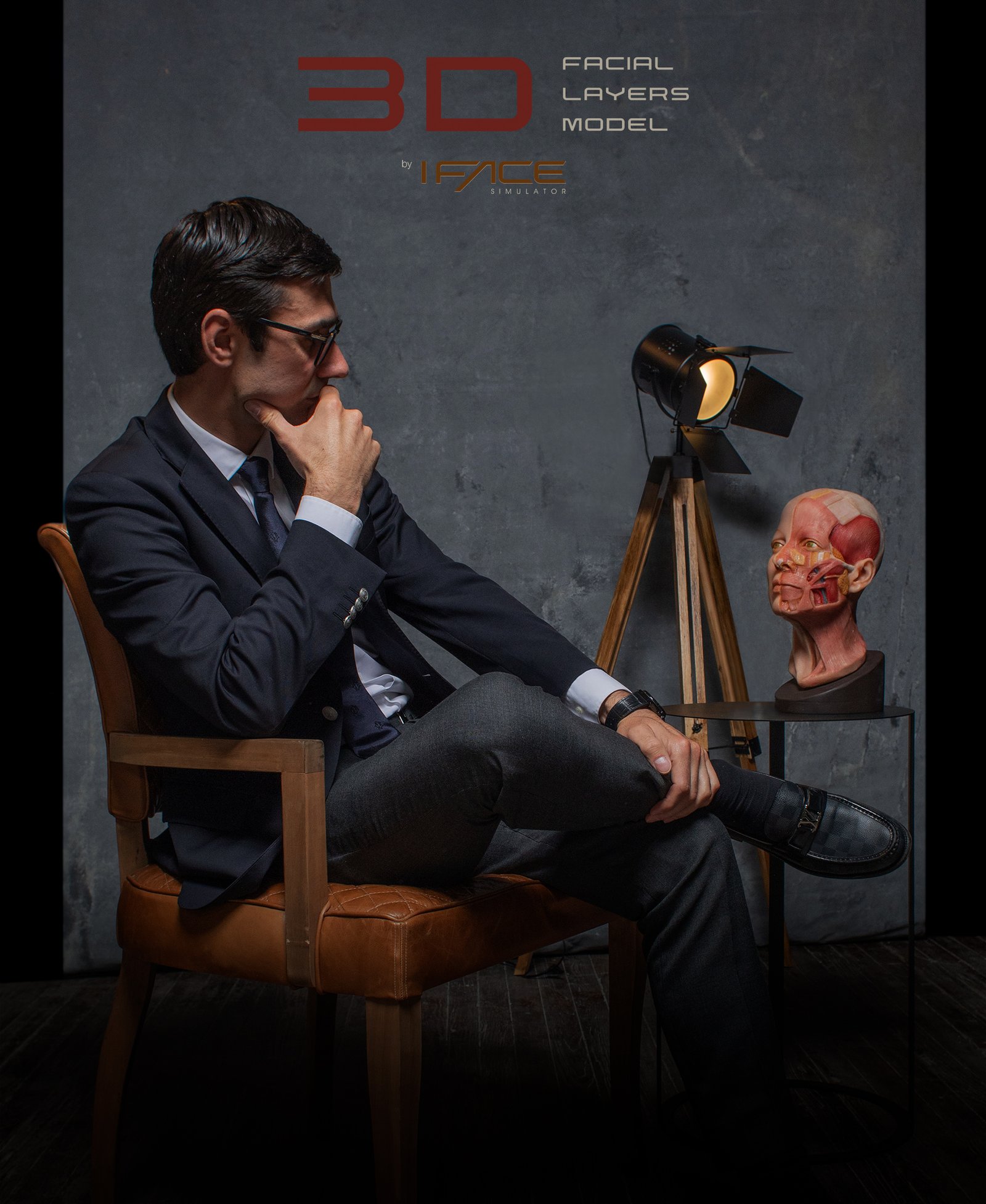
Congratulations on being the owner of the Windows E-Model!
We want to welcome you to the portal where you can experience the course that Prof. Sebastian Cotofana designed especially for you for acquiring the iFace. In this course, you will be able to learn about the layers of facial anatomy in a way that was never before possible. Today, you hold not only a unique model but also a piece with the most accurate anatomy in the market, as it was developed in partnership with the Prof. to achieve the highest level of realism possible.
Thank you, and we hope you enjoy and learn alongside iFace!
Click the play button below to preview the course that Prof. Sebastian Cotofana has specially prepared for you.
Course Curriculum:
Title: Course Title: Windows E-Model Program: Mastering Three-Dimensional Anatomy of the Face
Instructor: Professor Sebastian Cotofana
Duration: 15 minutes
Overview:
By obtaining the Windows E-Model, you will not only gain a unique and innovative model but also an exclusively designed course based on the model where you can learn about Three-Dimensional Anatomy of the Face. In this comprehensive educational program, we will explore the intricate layers and structures of the human face, all visualizable thanks to the Windows E-Model. This course is specifically tailored around the model to provide healthcare professionals, especially those involved in surgical or non-surgical procedures, with a deeper understanding of facial anatomy to enhance their clinical practice and improve patient outcomes.
Curriculum Outline:
Module 1: Introduction
– Introduction to the Course
– Understanding the Importance of Three-Dimensional Anatomy
– Overview of the Windows E-Model and its Advantages
Module 2: The Layers of the Face
– Understanding the Scalp and Its Layers
– The Five Layers of the Hand-Bearing Area
1. Skin
2. Superficial Fatty Layer (Connective Tissue)
3. Aponeurosis and its Connection to Frontalis Muscle and Galea Aponeurotica
4. Loose Connective Tissue
5. Periosteum Covering the Entire Skull
– The Relationship Between the Deep Temporal Fascia and Temporalis Muscle
– The Frontalis Muscle and its Connection to Depressor Supercilii Muscle
– Continuous Connection of Frontalis Muscle with Orbicularis Oculi Muscle
– Identification of Preserved Nasalis Muscle and its Superficial Location
Module 3: Understanding the Mid-Face Region
– Exploring the Superficial Nasolabial Fat Compartment
– Layers and Anatomy of the Suborbicularis Oculi Fat (SOOF)
– The Fascia Separating the SOOF from the Bone
– Identification of Pre-Periosteal Fat within the Prezygomatic Space
– Boundaries of SOOF and Pre-Periosteal Fat
– Relationship between Zygomatic Minor Muscle, LLSAN, and Orbicularis Oris
– The Role of Zygomaticus Major and Risorius Muscle in Facial Expression
Module 4: The Infraorbital Region and Masseter Muscle
– Location of the Parotid Duct and Parotid Gland in the Preauricular Area
– Superficial Location of the Masseter Muscle and its Role in Jaw Movement
– Identification and Palpation of the Facial Vein
– Covering of Structures by the Platysma Muscle
– Connection of Buccinator Muscle to the Modiolus
– Understanding the Modiolus’ Connection with Orbicularis Oris Muscle
Module 5: Conclusion and Clinical Applications
– Summary of Key Concepts and Layers of the Face
– Application of Three-Dimensional Anatomy in Clinical Practice
– Guidelines for Safer and More Effective Clinical Outcomes
We hope you are interested in acquiring the model and completing the Windows E-Model Program: Mastering Three-Dimensional Anatomy of the Face course! By doing so, you will not only have a unique educational tool but also gain a comprehensive understanding of facial anatomy and its layered structure. You can apply this knowledge to enhance your clinical practice and provide better care to your patients. We look forward to having you as part of this educational journey.